Retractable belt barriers last longest when belts are wiped with mild soap, dried while extended, retracted slowly and stored upright in a dry room. This guide from Custom Retractable Belt Barriers covers cleaning printed belts, storage between events, fixing belts that will not rewind, protecting posts and bases, and knowing when replacement printed cassettes beat another round of cleaning.
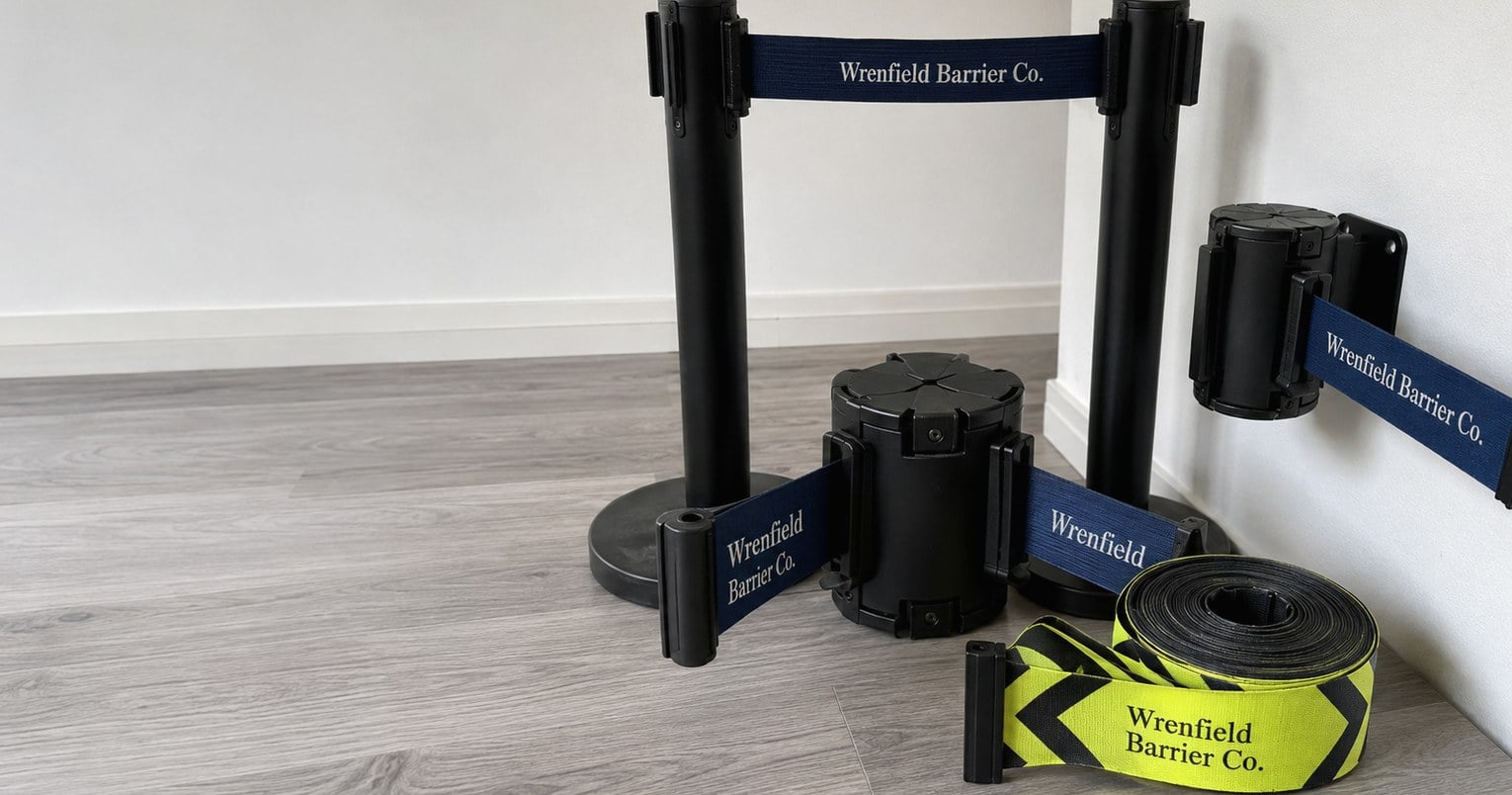
- Clean printed belts with a soft cloth, lukewarm water and mild soap, wiping along the belt
- Dry belts while extended and retract them slowly to protect the spring and print
- Store posts upright with belts retracted and clipped, away from sun and heat
- Replacement printed cassettes refresh worn belts without new posts; minimum order 12
- Free mockup within 24 hours, about 2 weeks standard turnaround
How do you clean a printed retractable belt without fading the logo?
Clean printed retractable belt barriers with a soft cloth, lukewarm water and a small amount of mild soap, wiping along the length of the belt rather than scrubbing across the print. Pull the belt out fully, lock it in place or hold it under light tension, and work one section at a time so the webbing never retracts while wet.
The printed face is where most damage happens. Harsh degreasers, bleach and solvent cleaners can dull ink and stiffen the webbing, so test any new cleaner on the underside near the end tab first. Never put a belt through a washing machine: the cassette cannot be removed from most housings without tools, and a soaked spring mechanism is the fastest route to a belt that will not rewind.
- Daily: dry wipe of the belt tops in high-touch queues such as checkouts and ticket lines.
- Weekly: damp wipe with mild soap, then a dry pass before retracting.
- As needed: spot-clean drink spills and scuffs while they are fresh.
Let the belt air-dry extended before you let it retract. Rolling up a damp belt traps moisture inside the cassette, which can leave marks on the print and corrode the spring over time.
How should you store retractable belt barriers between events?
Store retractable belt barriers upright, with every belt fully retracted and clipped, in a dry room away from direct sun and heat sources. Upright storage keeps weight on the base where it belongs and stops posts from rolling into each other and denting the housings that hold the printed cassettes.
Venues that set up a line only for events, such as museums with timed exhibitions or stores with a holiday overflow queue, tend to stack posts on their sides in a back corridor. That is where tops get cracked and belt ends get bent. A few simple habits prevent most of it:
- Retract each belt slowly by walking the end tab back to the housing instead of letting it fly.
- Clip the end into its own post receiver so it cannot unspool in transit.
- Keep the posts upright on a flat floor, or use a storage cart designed for stanchions.
- Group posts by belt message, so the right printed belts come out for the right event.
If you ordered more than one message, for example an everyday logo belt and a seasonal promotion belt, label the storage area by message. Printed belts look identical once retracted, and grabbing the wrong set is a common setup-morning surprise.
Why do retractable belts stop rewinding, and can you fix it?
Retractable belts usually stop rewinding because of a tired spring, a twisted belt or debris inside the cassette housing, and the fix is often a replacement printed cassette rather than a whole new post. The most common cause by far is snapping: letting a belt fly back at full speed shocks the spring and the end tab on every release.
Check for a twist first. Pull the belt out fully, straighten any fold near the slot and let it retract slowly. A belt that rewinds partway and then stalls often has a crease or grit at the slot opening. A belt that hangs slack with no tension at all generally has a spring that has given up.
When the spring or the webbing is the problem, the printed belt cassettes and replacement belts page is the place to start. Custom Retractable Belt Barriers prints replacement cassettes with your artwork, so you can refresh worn units without replacing the posts and bases you already own. This matters for brand consistency too: a single faded or blank belt in a row of crisp logo belts is the first thing a visitor notices.
Which belt materials and finishes last longest in heavy use?
For heavy daily use, choose a woven polyester belt with your artwork printed on both faces, matched to a housing and brake suited to the setting. Polyester webbing holds print well, resists stretching under constant tension and wipes clean, which is why it is the standard choice for printed retractable belt barriers in retail, transit and venue queues.
Where the belt lives matters as much as what it is made of. The table below sums up how setting changes the care plan.
| Setting | Main wear risk | What to choose and do |
|---|---|---|
| Indoor checkout or ticket queue | Hand contact, scuffs, frequent reconfiguring | Standard printed polyester belt, regular wipe-downs, slow retraction |
| Outdoor patio or entrance line | Sun, rain, grit in the cassette | Outdoor and heavy-duty belts, bring units in overnight, dry before retracting |
| Long gaps across lobbies or loading areas | Sag and extra spring load | Long-span belt barriers rather than an overextended standard belt |
| Doorways and corridors | Belt left extended for long periods | Wall-mounted and corner units with the belt clipped at a receiver |
Matching the product to the setting is the single biggest factor in belt life. An indoor belt stretched across a windy outdoor entrance every day will wear faster than any cleaning routine can offset.
Does sunlight fade printed retractable belt barriers?
Sunlight will gradually soften the colors on any printed retractable belt barrier, so belts that face direct sun every day should be built for outdoor use and stored indoors when the line is closed. Fading is slow and even, which means a belt that lives by a sunny window can look fine alone but dull next to a fresh replacement.
A few choices reduce the effect. Darker belt colors with light print tend to show fading less obviously than pale belts with saturated logos. High-contrast designs stay readable longer because the message survives even as colors mellow. If a queue sits beside a glass storefront, consider rotating belts between the sunny and shaded positions so the whole set ages evenly.
Plan replacements as a set when appearance matters most. Ordering a full run of new printed cassettes at once keeps every belt in the line the same shade, and the minimum order of 12 covers most single-location queues comfortably.
How do you protect the posts, bases and cassette housings?
Protect the posts and bases of retractable belt barriers by moving them upright, never by dragging them by the belt or tipping them across the floor. Dragging is the main reason bases scratch floors, tops crack and belts get yanked out at an angle that damages the slot.
- Move by the post, not the belt. Tilt the post slightly and roll the base edge, or lift it, instead of pulling on an extended belt.
- Keep receivers clear. Dust and grit in the clip receivers make end tabs stick and encourage people to force them.
- Check rubber base rings. Worn or missing floor protectors leave marks and let posts slide on smooth floors.
- Tighten loose tops. A wobbling top lets the cassette shift, which can twist the belt as it rewinds.
When a layout uses several belts per post, the four-way receivers and linking hardware takes more strain than a simple two-post line. Inspect those junction posts more often, because they carry the load of multiple belts pulling in different directions.
When should you replace retractable belt barriers instead of cleaning them?
Replace a printed retractable belt barrier when the belt no longer retracts fully, the webbing is frayed at the slot or end tab, the brake no longer slows the return, or the print is faded enough that the message is hard to read from the line. Cleaning restores appearance, but it cannot fix a worn spring or frayed edge.
A simple quarterly walk-through catches most issues before visitors do. Extend every belt, check both printed faces, let each one retract and note any that stall, snap or sag. Retire damaged belts from public queues right away: a belt that whips back can startle guests, and a fraying belt looks careless next to branded signage.
Replacement is also the right moment to update your artwork. If your logo, colors or queue messages have changed since the first order, a new set of printed cassettes brings the line up to date. Custom Retractable Belt Barriers returns a free mockup within 24 hours, offers unlimited free revisions, and you pay nothing until you approve the design. Standard turnaround is about 2 weeks, with faster turnaround available through express shipping.
What does a simple care routine look like for a busy site?
A workable care routine for retractable belt barriers takes only a few minutes a day: wipe the belts, retract them slowly at close, keep posts upright, and log any unit that stalls. Assigning one person per shift to own the queue hardware keeps the routine from slipping.
- Opening: check every belt extends smoothly and clips into its receiver.
- During the day: spot-clean spills, straighten twisted belts, and stop staff from releasing belts to snap back.
- Closing: walk each belt back, clip it, and stand posts in their storage spot.
- Weekly: damp wipe of both printed faces and a dry pass before retracting.
- Quarterly: full inspection and a list of cassettes to replace.
Ready to refresh worn belts or set up a new branded queue? Send your logo through the custom quote form, or read how it works to see each step from mockup to delivery.
Frequently asked questions
Can printed retractable belt barriers be cleaned with disinfectant wipes?
Printed retractable belt barriers can usually be wiped with mild disinfectant wipes, but test the wipe on the underside near the end tab first. Strong alcohol or bleach products can dull the print over time. Wipe along the belt, let it dry while extended, and only then let the belt retract slowly into the cassette.
How often should retractable belt barriers be cleaned in a busy queue?
Retractable belt barriers in a busy queue benefit from a quick dry wipe each day and a damp wipe with mild soap each week. High-touch lines, such as checkouts and ticket counters, may need more frequent spot cleaning. Custom Retractable Belt Barriers recommends drying belts fully before retracting them to protect the print and spring.
Why does a retractable belt barrier twist when it rewinds?
A retractable belt barrier twists on rewind when the belt is released at an angle or allowed to snap back quickly. The webbing folds at the slot and rolls in crooked. To fix it, pull the belt out fully, flatten the fold, and walk the end tab back slowly so the belt enters the housing straight.
Should retractable belt barriers be stored with the belts extended?
Retractable belt barriers should be stored with belts fully retracted and clipped, never left extended. An extended belt keeps the spring under constant tension, collects dust and can be snagged or stepped on. Retract slowly, clip the end into the post receiver, and stand the posts upright in a dry room away from heat and sun.
Can faded printed belts be swapped without changing the logo design?
Faded printed retractable belts can be swapped for fresh replacement cassettes using the same artwork as your original order. Custom Retractable Belt Barriers keeps the process simple: send the logo again or reference your earlier design, approve a free mockup returned within 24 hours, and the new belts are produced in about 2 weeks.
Do dark or light retractable belt colors hide wear better?
Dark retractable belt colors such as black or navy generally hide scuffs, hand marks and gradual fading better than pale belts. Light belts with bold logos look sharp when new but show dirt sooner in busy queues. Choose a dark belt with high-contrast print if the barriers will see heavy daily handling or sun exposure.
What is the fastest way to damage a retractable belt barrier?
Letting a retractable belt barrier snap back at full speed is the fastest way to damage one. Each hard release jolts the spring, strains the end tab and can crack the housing. Dragging posts by an extended belt is a close second. Walk belts back slowly and move posts by lifting or rolling the base.
Can retractable belt barriers be left outside overnight?
Retractable belt barriers built for indoor use should come inside overnight, because rain, dew and grit get into the cassette and wear the spring. Outdoor and heavy-duty belts from Custom Retractable Belt Barriers handle outdoor setups better, but even those last longer when stored dry and retracted between events rather than left out.
How can staff tell when a retractable belt cassette needs replacing?
Staff can tell a retractable belt cassette needs replacing when the belt rewinds only partway, hangs slack with no tension, frays at the slot or end tab, or retracts without the brake slowing it. Faded print that is hard to read from the line is another sign. Replacement cassettes keep existing posts in service.
Is it worth ordering spare printed cassettes for retractable belt barriers?
Ordering spare printed cassettes for retractable belt barriers is worth it for busy sites, because a damaged belt can be swapped the same day instead of leaving a gap or a mismatched blank belt in a branded line. Including spares in the original run also keeps colors identical, since every belt is printed together.
Does moving retractable belt barriers often shorten their life?
Moving retractable belt barriers often does not shorten their life when posts are moved correctly. Retract and clip belts before moving, then lift or roll each post by the base edge. Problems come from dragging posts by an extended belt or tipping them over, which scratches bases, cracks tops and twists belts inside the housing.
What should a care checklist for retractable belt barriers include?
A care checklist for retractable belt barriers should cover smooth extension and retraction, clean printed faces on both sides, secure clips and receivers, intact rubber base rings, tight post tops and readable messages. Custom Retractable Belt Barriers suggests a quick daily check, a weekly wipe-down and a fuller quarterly inspection to plan any replacements.
Get a free mockup for your retractable belt barriers
Send your logo or idea and the quantity you have in mind. Custom Retractable Belt Barriers returns a free mockup within 24 hours, you approve the design before anything is produced, and standard turnaround is about two weeks with faster options available. Get a custom quote.