Almost every buying decision on a retractable belt barrier goes into the post and the belt — the finish, the belt color, the print. The base gets treated as whatever comes bolted to the bottom. That is backwards. The base is the part that decides whether a line actually holds when a crowd leans on it, whether the post scratches a marble lobby floor, whether one person can rearrange a queue in two minutes or needs a hand truck, and whether the barrier survives a windy afternoon outdoors. This is a straight comparison of the base styles you will be offered, what each one weighs, how much floor it takes, and the setting each is built for.
Why the base, not the post, decides whether a line holds
A standard stanchion post stands about 40 inches tall, and the belt clips on near the top. That height is a lever. When someone leans on the belt, sets a bag against a post, or yanks a belt across a gap, the force acts at the top of the post and tries to rotate the whole unit around the edge of its base. Two things resist that tipping moment: how much the base weighs and how wide it is. A heavier base takes more force to lift; a wider footprint moves the tipping edge farther out. This is also why belt length matters to base choice — a longer belt pulled taut applies more sideways load, so a 13-foot belt paired with a light base is far tippier than the same base with a 7-foot belt. Match the base to the tension it will actually see, not just to the room it sits in.
Cast iron: the default, and how heavy is heavy enough
Cast iron is the workhorse. A standard sloped cast-iron base runs around 18 pounds on a footprint of roughly 14 inches, which is enough for typical indoor queues with short-to-medium belts. Two variations solve specific problems. A low-profile cast-iron base drops the height to about five-eighths of an inch so wheelchairs, luggage carts and hand trucks can roll over the edge without catching — useful on accessible routes even though it carries a bit less mass. At the other end, heavy-duty cast-iron bases reach 27 to 30 pounds for taller posts, longer belts, or high-traffic public spaces where surge loads are routine. The chart below lines up the common styles by weight so you can see where each sits.
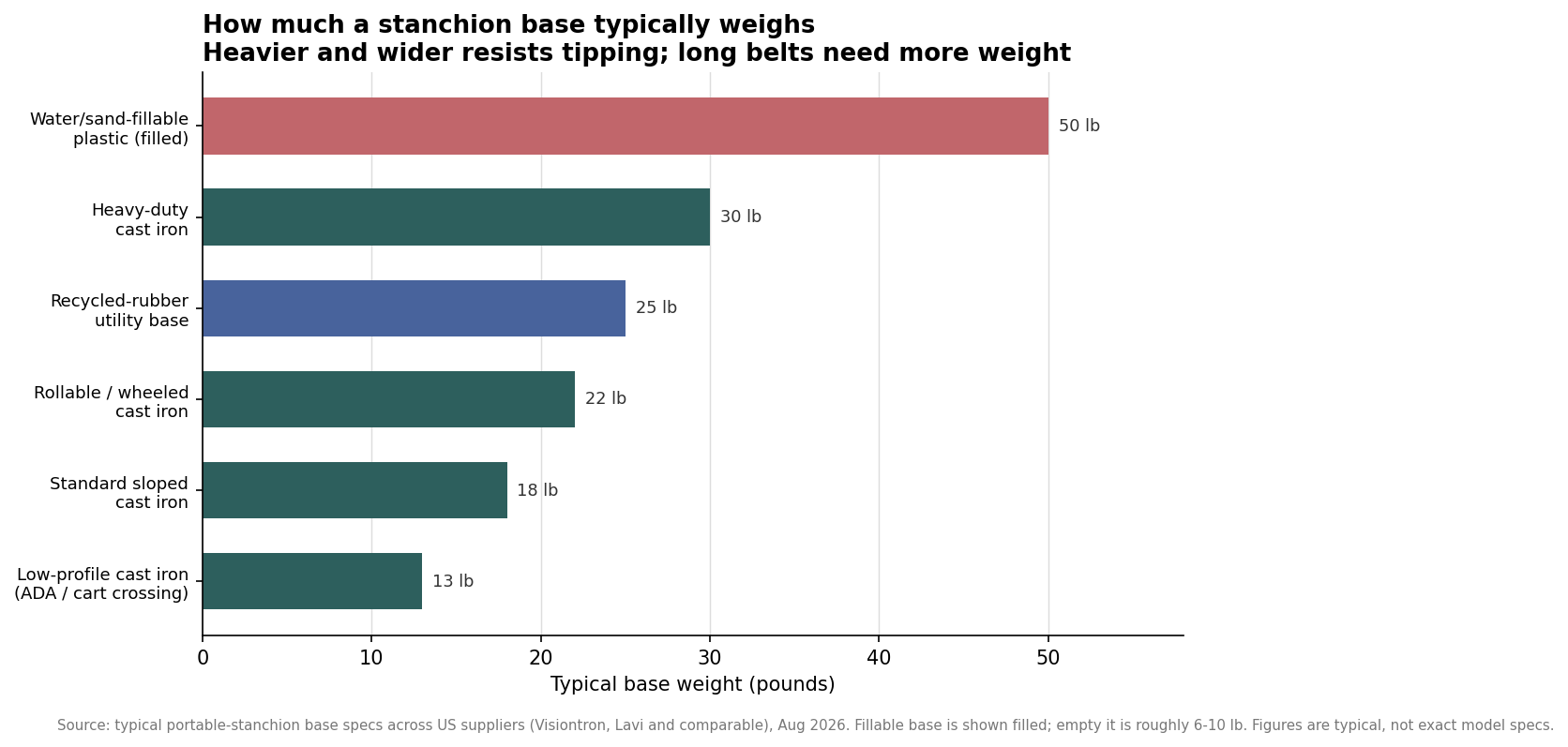
The practical rule: step up the base weight as belt length, post height, and crowd energy go up. A museum rope line with a 7.5-foot belt is fine on a standard base; an airport queue that funnels hundreds of rolling bags past a 13-foot belt wants the heavy version. And whatever the weight, check that the base has a felt or rubber pad underneath — bare cast iron will scratch stone, terrazzo and wood floors, and a scratched lobby floor costs more than the whole set of posts.
Low-profile, rollable and rubber: solving specific problems
Beyond plain cast iron, three styles exist to fix a particular headache. The rollable or wheeled base hides small casters under the cast iron so one person can tilt and roll a post to reconfigure a queue in seconds — the right pick for hotels, banquet spaces and events where the layout changes several times a day. Recycled-rubber utility bases trade a bit of polish for near-indestructibility: they shrug off outdoor weather and bumps from carts, and many stack several deep in about a 14-by-14-inch footprint for storage between events. The low-profile base already mentioned doubles as the accessibility answer where a raised base edge would be a trip hazard. None of these is “better” in the abstract; each buys you one specific advantage at a small cost somewhere else.
Fixed and fillable: the two extremes
At the permanent end sit surface-mount options. A flange or fixed base bolts to the floor and is effectively impossible to tip — the correct choice for security checkpoints, bank teller lines and any lane that never moves. Mini-socket mounts are a lighter-touch version that drop the post into a small hole (under an inch across) and suit thin floors like tile or terrazzo, while removable mounts let you pull the posts for cleaning. The trade is obvious: maximum stability, minimum flexibility, and a floor you have drilled into.
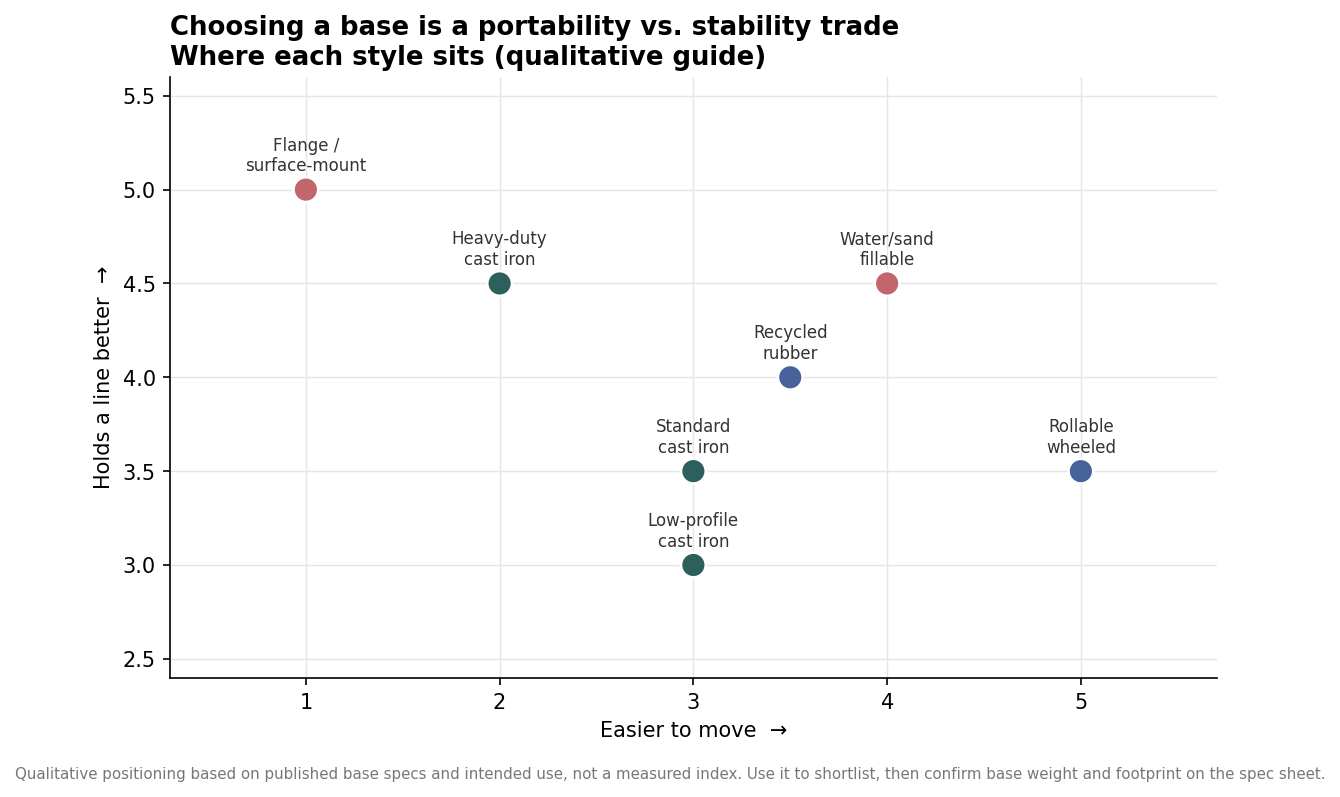
At the temporary end sit water- or sand-fillable plastic bases. Empty they weigh only single digits, so one person can carry a stack to a parking lot or field; filled they reach roughly 40 to 60 pounds for real outdoor stability against wind and jostling. Sand is usually the better fill — it will not leak, evaporate or freeze and crack the base the way water can in cold weather. The chart below maps every style on the two axes that actually drive the decision: how easily you can move it against how well it holds a line.
Matching the base to the room
Reading the map from corner to corner gives you a quick shortlist. A smooth indoor floor with layouts that change often points to a rollable cast-iron base. An accessible path where carts and chairs cross the line points to low-profile. A permanent security or teller lane points to a flange mount. An outdoor event points to fillable plastic or recycled rubber. And any setting with long belts or genuine crowd surge points to the heaviest cast iron you are willing to lift. Whatever you shortlist, put two numbers on the specification before you order: the base weight in pounds and the footprint diameter in inches. Those two figures, plus a note about floor protection and whether the line is indoor or outdoor, separate a barrier that stays where you put it from one that ends up on the floor with a customer standing over it.